
Setting Standards for FIGG Practitioners
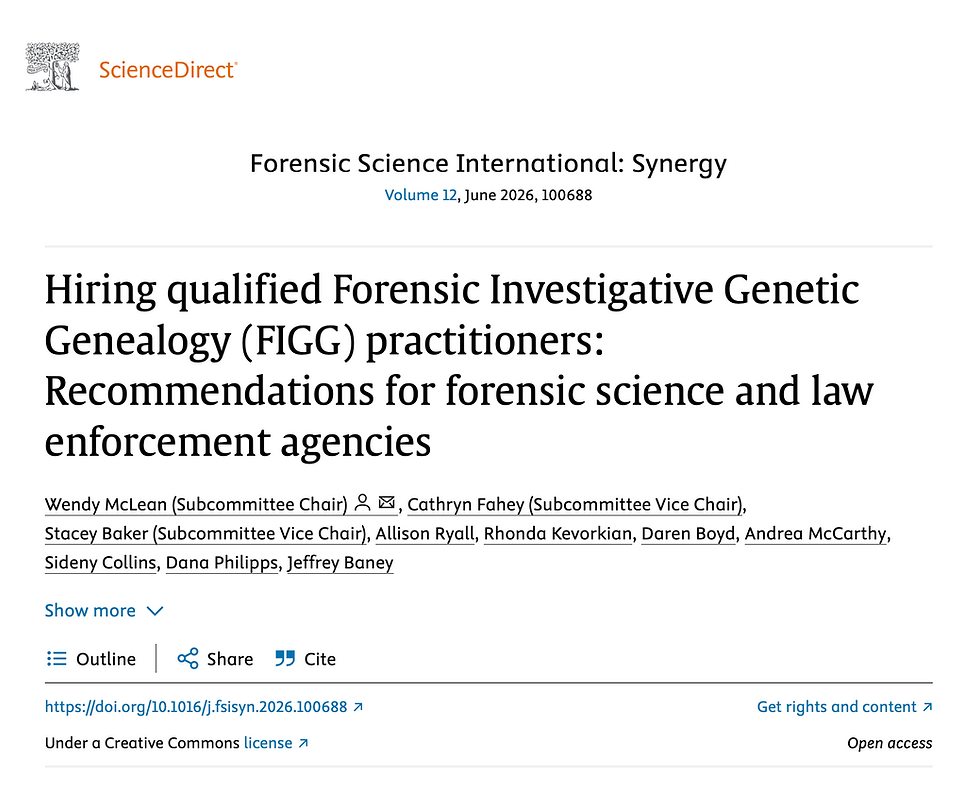
Forensic Investigative Genetic Genealogy (FIGG) has gone from a novel technique to a working tool for cold cases in a very short time. However, some might say the field has moved faster than the guardrails around it. More and more agencies are bringing FIGG in-house, which is a good thing, but some are doing so without a shared sense of what "qualified" actually means.
That's the gap our new paper tries to help close. As part of NTVIC's Public Entity Investigative Genetic Genealogist Subcommittee, my co-authors and I put together a set of recommendations for hiring a FIGG practitioner including outlining the role, education and credentials to consider, and defining the knowledge and skill sets that separate candidates.
We did so knowing that standards in an emerging field are tricky. Set them too low and the integrity of the work could be questioned. Set them too narrow and you lock out the practitioners who built the field in the first place. Instead, what we tried to do is offer a reasonable baseline.
None of this is final, but more of a consensus of perspectives from some of us doing the work currently. The hope is that the more the field can agree on a baseline, the more agencies can hire with confidence and the more the public can trust the outcomes. That feels like a hopeful direction to be heading. I’m grateful to have worked alongside this group, and I'm looking forward to seeing how the next few years define our field.
You can find the paper here: https://www.sciencedirect.com/science/article/pii/S2589871X26000318
Comments